
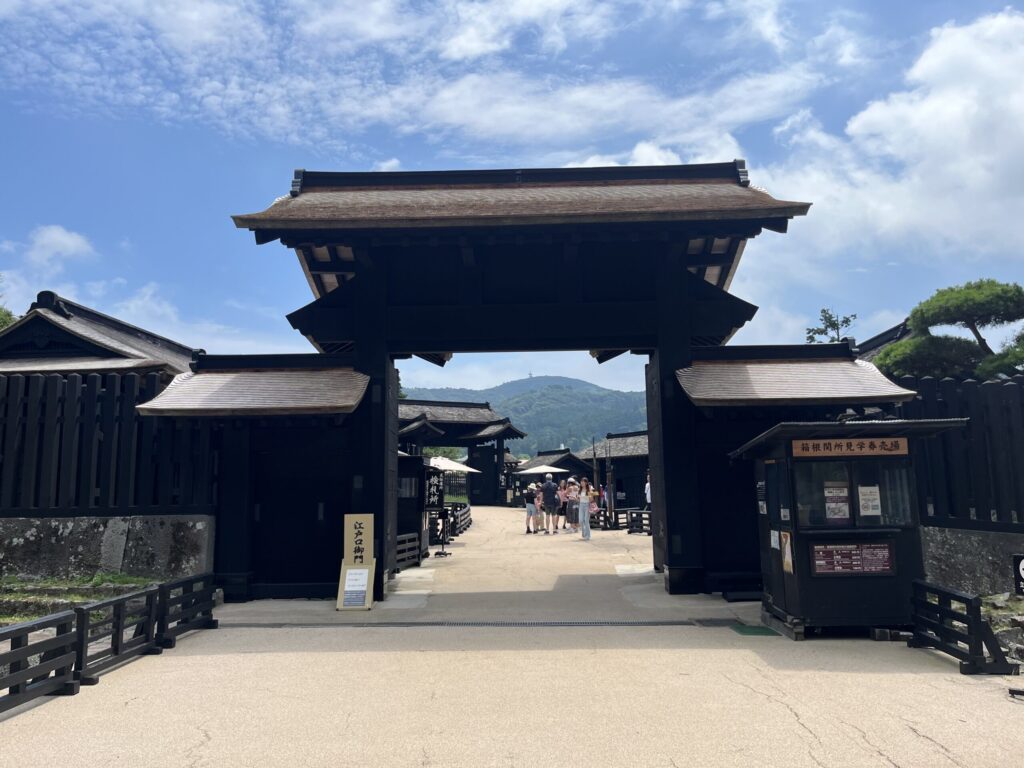
Hakone Sekisho wasn’t somewhere I travelled across Hakone specifically to see.
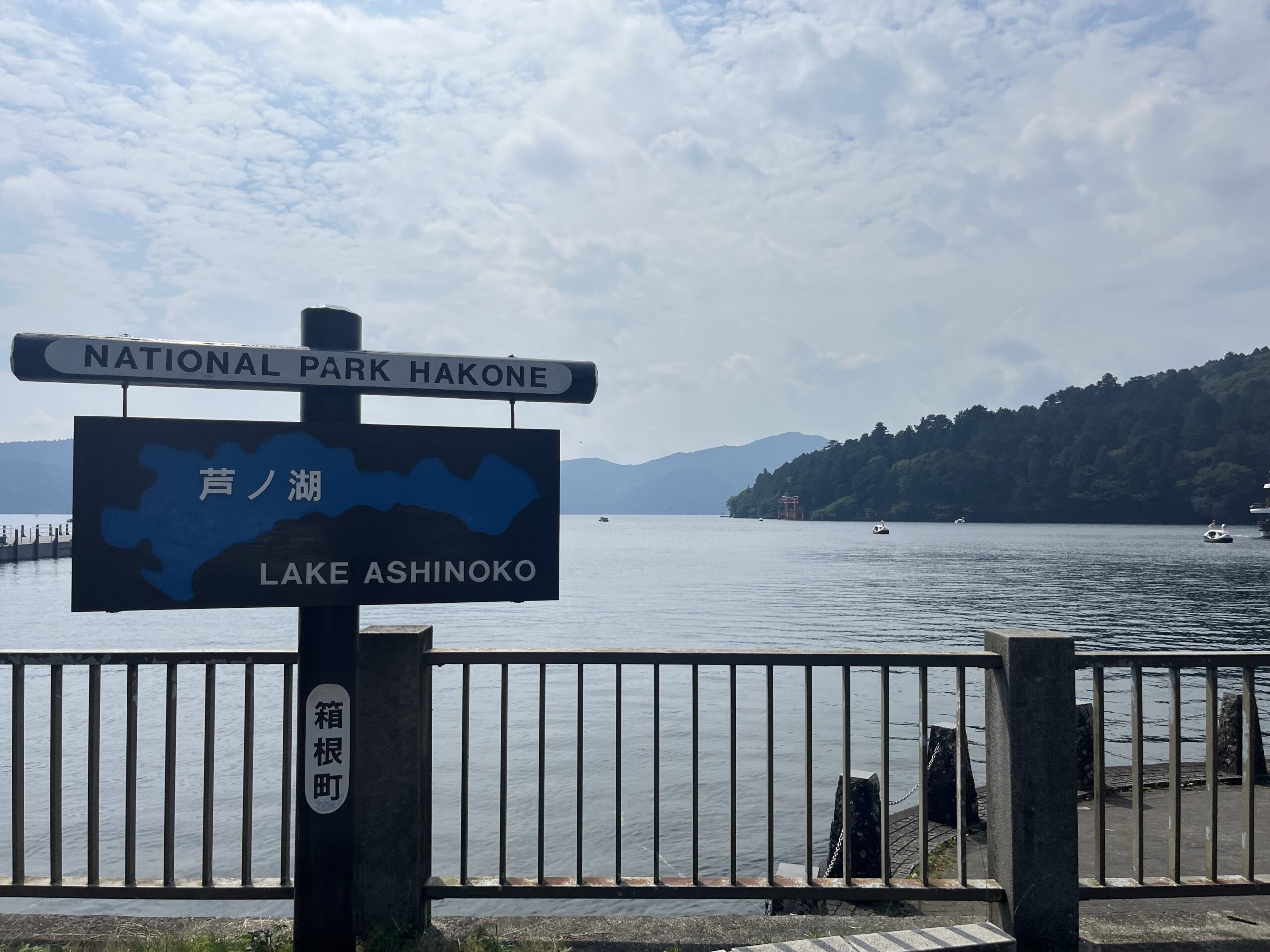
I simply reached it while walking around Lake Ashi.
My route that day took me from Motohakone to Hakone Shrine, along Lake Ashi, through Onshi-Hakone Park and eventually to Hakone Sekisho. From there, I continued towards the Hakone Ekiden finish area.
And if I’m being completely fair, Hakone Sekisho isn’t the kind of attraction that’s going to stop you in your tracks.
There are no enormous temples or dramatic views waiting behind the gate.
But standing there made me think about something I hadn’t really considered before.
What would it actually have felt like to pass through here 300 years ago?
I’d heard of Hakone Sekisho before. I’d learnt that it was an important checkpoint on the road towards Edo.
But seeing the black buildings beside Lake Ashi made that history feel a little more real.
I remember thinking:
So this is what a checkpoint actually looked like.
And once I started thinking about the people who had to cross the Hakone mountains on foot, the place became much more interesting.
What Was Hakone Sekisho?
During the Edo period, the Tokugawa shogunate controlled travel along Japan’s major roads through checkpoints known as sekisho.
Hakone Sekisho stood on the Tokaido, the major route connecting Edo — modern-day Tokyo — with Kyoto and western Japan.
The checkpoint is thought to have been established at its present location around 1619. Hakone’s official historical material describes it as one of the important checkpoints monitoring the Tokaido.
And its location makes sense when you see it.
Hakone isn’t an open plain.
It’s mountainous.
Routes through it are naturally restricted, and Lake Ashi sits right beside the checkpoint.
Even today, travelling through Hakone means climbing and descending through the mountains.
Put guards here, control the road, and you’ve got a very effective place to monitor people moving towards and away from Edo.
What Did They Actually Check?
This was the part I found particularly interesting after reading more about Hakone Sekisho.
There’s a famous expression associated with Edo-period checkpoints:
iri-deppō ni de-onna — “incoming guns and outgoing women”.
The basic idea was to control weapons entering Edo and closely monitor women leaving it, particularly women connected to feudal lords whose families were kept in Edo under the shogunate’s system of control.
But there’s an important detail.
Hakone Sekisho itself did not inspect incoming guns.
Its particularly strict role was the inspection of de-onna — women travelling out of Edo towards western Japan.
Women who required permission had to carry documents, and officials checked whether the traveller matched the description written in them. A female official known as a hitomionna could carry out detailed physical checks.
Other travellers weren’t necessarily waved straight through either.
Official records describe travellers removing hats or head coverings so their faces could be checked. Officials could inspect people travelling in palanquins, while injured people, the dead and suspicious travellers could require documentation.
Interestingly, not everybody needed a travel permit. According to Hakone Sekisho’s historical records, some ordinary male travellers could pass without one after being questioned about things such as where they came from, where they were going and why they were travelling.
That made me think differently about the gate I’d just walked through.
I’d Probably Have Been Nervous — Even With Nothing to Hide
Imagine approaching this place when it was actually operating.
There are guards ahead of you.
You’re about to be questioned.
They’re watching people coming through.
You’ve done nothing wrong.
You’ve got nothing to hide.
And yet…
I’d probably still have been slightly nervous.
It’s a bit like going through immigration today.
You know perfectly well you haven’t done anything wrong, but when the officer looks at your passport and starts asking questions, there’s still that tiny voice in your head going:
I haven’t accidentally committed a crime, have I?
Standing at Hakone Sekisho made me imagine something similar.
Before visiting, I hadn’t really thought about what a sekisho physically looked like.
Somewhere in my head, I’d imagined a big gate with a guard standing beside it.
That was about it.
Hakone Sekisho felt bigger than that.
Then again, considering how important the Tokaido was, perhaps I shouldn’t have been surprised.
I Didn’t Pay to See the Exhibition
This is worth making clear.
I didn’t visit the paid exhibition.
I walked through the accessible part of the checkpoint, looked around, took some photos and continued on my way.
The reconstructed buildings and exhibition require an admission ticket, and on that particular day I decided to skip it.
Part of me was a little disappointed that I couldn’t see more without paying.
It would’ve been a good opportunity to learn more about what people actually did here.
But I thought:
Ah well. I’ve got a feel for the place.
And carried on.
So if you’re looking for a detailed review of the exhibition itself, I can’t give you one.
The official site currently lists standard adult admission at ¥500 and suggests around 45 minutes for a normal visit.
My visit was much shorter because I wasn’t doing that.
And that’s an important distinction.
Then There’s the View
One thing I did really like about the location was Lake Ashi.
The checkpoint sits beside the lake, surrounded by the Hakone mountains.
Looking out from around Hakone Sekisho towards that blue-green water almost makes the place feel too peaceful for its former purpose.
It’s quite easy to stand there now, take a photograph and move on.
A few hundred years ago, this was a controlled gateway on one of Japan’s most important roads.
That’s quite a contrast.
What Is Hakone Hachiri?
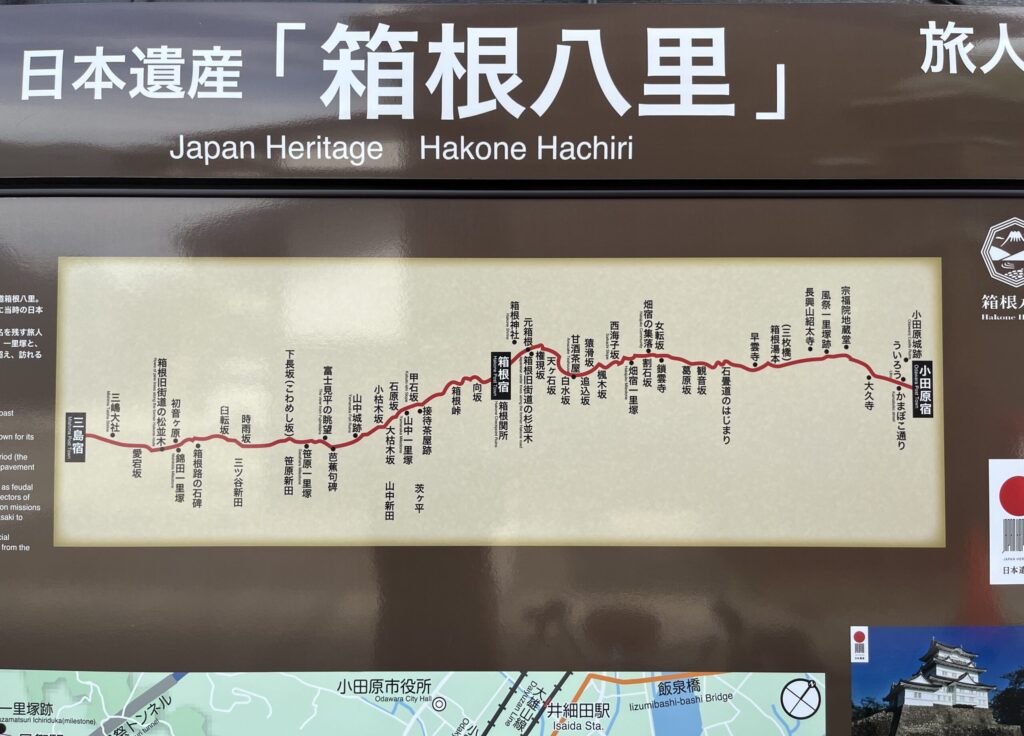
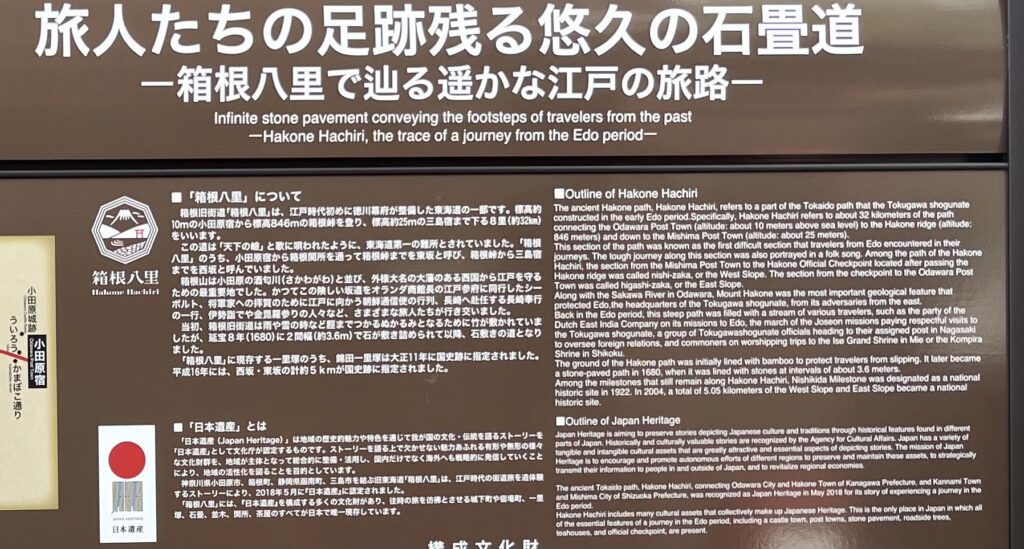
To understand why Hakone Sekisho mattered, you also need to understand Hakone Hachiri.
Hachiri literally means “eight ri”.
The route connected Odawara-juku and Mishima-juku, crossing the Hakone mountains for roughly 32 kilometres.
It formed part of the Tokaido and was regarded as one of its most difficult sections because of the long, steep climb through the mountains.
Parts of the old route were eventually paved with stone. Historical records from Mishima explain that bamboo was initially laid on the slippery ground before stone paving was introduced in 1680.
Today, Hakone Hachiri — together with historical sites along the route — is recognised as a Japan Heritage story stretching across Odawara, Hakone, Kannami and Mishima.
I seem to come across the words Hakone Hachiri quite often around this area.
One place I definitely remember seeing an explanation was around Kamaboko Street in Odawara.
Once you know what the name means, the geography of this whole area starts fitting together.
Odawara.
Hakone.
Lake Ashi.
Hakone Sekisho.
Mishima.
They’re not just separate tourist destinations.
They were points along a road people had been travelling for centuries.
And People Actually Walked This
This is the part that gets me.
I’ve walked plenty around modern Hakone.
And Hakone is steep.
Today, of course, it isn’t a major problem.
We’ve got trains.
We’ve got buses.
We’ve got cars.
There are paved roads everywhere.
If you’re tired, you get on something and let an engine deal with the mountain.
But imagine doing this journey on foot.
No train.
No bus.
No nicely paved road.
Just you, the mountains and whatever you’re carrying.
Hakone Hachiri climbed from low-lying Odawara and Mishima towards the Hakone Pass, which sits at an elevation of around 846 metres.
People weren’t crossing these mountains because they fancied a weekend hike either.
The Tokaido was one of Edo Japan’s great transport arteries. Daimyo, officials, merchants and other travellers used the route, while historical records connected with Hakone Hachiri also include journeys by groups such as Korean envoys and Dutch trading representatives.
Some people would have been transporting things as part of their journey too.
I can’t help but admire them.
People must have been incredibly tough.
Walking over mountains on rough roads was simply part of travelling.
I’d actually quite like to try walking the old route myself one day.
Although I reckon there’s about a 100% chance I’d start off thinking,
This is brilliant. I’m literally walking the old Tokaido.
and several hours later I’d be wondering why on earth I thought this was a good idea.
I Haven’t Walked the Old Tokaido Yet
I should make another distinction here.
Although I’ve walked plenty of steep roads around Hakone, I haven’t walked the preserved old Tokaido or the Hakone Hachiri route itself.
So I’m not going to tell you what the stone-paved trail is like underfoot or how difficult the historic walking route is.
That’ll have to wait until I actually do it.
What I can say is that experiencing modern Hakone’s terrain has made me appreciate the historical route much more than I did when I first learnt about it.
A line in a history book saying “Hakone was a difficult mountain crossing” doesn’t mean much.
Walk up a steep hill in Hakone for yourself and suddenly it makes a bit more sense.
Is Hakone Sekisho Worth Visiting?
This depends heavily on what you’re interested in.
I wouldn’t travel across Hakone specifically for Hakone Sekisho alone.
If you’re expecting a spectacular attraction, I think you could come away disappointed.
It’s historical rather than flashy.
And if you’re not particularly interested in Japanese history, there are other places I’d prioritise on a first trip to Hakone.
But that’s not how I’d suggest visiting it anyway.
I’d make it part of a walk.
My route was:
Motohakone → Hakone Shrine → Lake Ashi → Onshi-Hakone Park → Hakone Sekisho → Hakone Ekiden finish area
That worked well.
You get the shrine and cedar trees first, then Lake Ashi, the views from Onshi-Hakone Park, a bit of Edo-period history at the checkpoint, and finally the Hakone Ekiden finish area.
In that context, I think Hakone Sekisho makes much more sense.
You’re not travelling somewhere solely to see a checkpoint.
You’re encountering it as part of the landscape and history around Lake Ashi.
If you’re seriously interested in the Edo period, though, that’s different.
In that case, I’d pay for the exhibition and spend more time here than I did.
Hakone Sekisho official website
Why Was Hakone So Important During the Edo Period?
If someone asked me this now, I’d explain it like this:
Hakone sat on the Tokaido between Edo and western Japan.
But geography made that road special.
Travellers had to cross a difficult mountain pass, and the route naturally funnelled people through a limited number of places.
That made Hakone a useful place for the Tokugawa shogunate to monitor movement along one of Japan’s major roads.
Hakone Sekisho was therefore not just some random gate in the mountains.
It was part of a much bigger system connecting roads, politics and control during the Edo period.
And I think that’s what made the checkpoint more interesting to me than the buildings themselves.
I didn’t spend very long there.
I didn’t even see the paid exhibition.
But after looking at the gate, Lake Ashi and the mountains around it, I could finally picture the history a little better.
People really walked across these mountains.
And before continuing towards Edo or Kyoto, many of them had to pass right through here.