
I spent three months in Takayama, and one of the things I enjoyed doing on my days off was simply walking.
I wasn’t following a carefully planned temple route. I didn’t visit all of these places in a single day either.
Sometimes I’d look at Google Maps, spot a shrine or temple that looked interesting and wander over. Other times I’d just come across one while walking around town.
I’m not particularly religious. I just like being in these places.
The trees, the wooden buildings, the stone paths and the quiet atmosphere somehow made walking around Takayama even more relaxing.
So this isn’t an “ultimate” list of every shrine and temple you need to see.
These are simply five places I came across during my time in Takayama that stuck in my memory.
If you enjoy walking and have some spare time after seeing Takayama’s main sights, they’re worth knowing about.
1. Sakurayama Hachimangu


Of all the shrines I visited in Takayama, Sakurayama Hachimangu made one of the strongest first impressions on me.
Before you even reach the main shrine grounds, there’s a huge torii near the bridge.
It’s difficult to miss.
From there, the approach leads straight towards the shrine, surrounded by tall trees. I remember the grounds feeling spacious and remarkably well kept, with stone paths running between the wooden buildings.
It was the sort of place that naturally made me slow down and have a proper look around rather than take a quick photo and leave.
But one of the things I remember most was actually a much smaller discovery.
Next to one of the smaller shrines, I stopped to read an information board.
And there was a name I recognised immediately:
Ryomen Sukuna.
Hang on. As in Jujutsu Kaisen?
The sign was about Takefurukuma no Mikoto, and explained that he had been sent to subdue Ryomen Sukuna in Hida.
I knew the name Sukuna from Jujutsu Kaisen, of course, but I had no idea there was a much older story behind the name, let alone one connected with Hida.
I hadn’t gone to Sakurayama Hachimangu looking for anything to do with Sukuna. I simply happened to read the sign while wandering around.
That’s exactly the sort of random discovery I enjoy when I’m exploring somewhere without much of a plan.

I wasn’t expecting to come across the name Ryomen Sukuna while wandering around the shrine.
There was another small detail I liked too.
Next to the more impressive shrine buildings, I noticed a little weathered-looking shrine. Compared with the larger, well-maintained structures around it, this one looked rather rustic.
I don’t really know why, but I liked it.
Again, it wasn’t some major attraction. It was just one of those little things I happened to notice because I was taking my time.
Sakurayama Hachimangu is also associated with Takayama’s autumn festival. I wasn’t in Takayama for the festival itself, unfortunately, so that’s one reason I’d like to come back.
But even without the festival, I enjoyed the shrine simply as somewhere to wander around.
I’d allow around 30 minutes if you want to take your time rather than just walk in, pray and leave.
2. Hida Soja

Hida Soja left a different impression on me.
What I remember most isn’t a particular historical fact or decoration.
It’s the approach.

Near the torii stood a large stone monument that immediately caught my attention.
Then, once I looked through the torii, the approach ran almost straight towards the worship hall.
It was immaculate.
There was barely a speck of rubbish on the ground. Everything looked carefully maintained, right down to the edges of the path.
And there at the end, directly in your line of sight, stood the worship hall.
It had a surprisingly powerful presence from that angle.
Historically, Hida Soja has an interesting purpose too. A soja brought together the deities of shrines within a province, allowing the provincial governor to conduct worship in one place rather than travelling to every shrine individually. Hida Soja is believed to have been founded during the Heian period.
I didn’t know all of that when I first walked in.
And that’s fine.
What stayed with me wasn’t the history lesson.
It was that perfectly clean, straight approach and the shrine waiting at the end of it.
3. Hida Kokubunji

Hida Kokubunji is different from the other places on this list because I’ve now written an entire article about it.
It was the first kokubunji I’d ever actually visited.
I’d learnt at school that Emperor Shomu ordered provincial temples to be established across Japan in the eighth century, so there was something slightly strange about finally walking into one myself.
But you don’t need to know much about Japanese history to stop here.
There’s a three-storey pagoda and an enormous old ginkgo tree, and it’s very close to Takayama Station.
You also don’t need long. I probably spent less than 20 minutes walking around on a normal visit.
What made this place stay with me wasn’t really the amount of time I spent there.
I saw it on different occasions while I was living in Takayama — including around Setsubun, when oni were lined up by the entrance.
And one night, I saw the moon above the three-storey pagoda.
That’s probably my strongest memory of the place.
→ Read my full Hida Kokubunji guide here.
4. Daiou-ji

Daiou-ji is over on the eastern side of Takayama, in the Higashiyama temple area.
The temple was moved to its present location after Kanamori Nagachika took control of Hida in the late sixteenth century. Its bell tower dates from 1689 and is described by Takayama’s official tourism site as the oldest surviving bell tower in the Hida region.
But again, that isn’t really why it belongs in this article.
For me, Daiou-ji was part of exploring this quieter side of Takayama.
Once you move away from the Old Town and towards Higashiyama, the atmosphere starts to change.
There are temples, trees and quieter roads, and walking around here felt quite different from walking through the busier tourist streets.
Daiou-ji was one of the places I came across while exploring that area.
And not far away was somewhere I liked even more.
5. Higashiyama Hakusan Shrine

Higashiyama Hakusan Shrine was probably one of my favourite places to wander around.
Not because there was some huge attraction waiting at the end.
Quite the opposite.
What I liked was the setting.
Trees surrounded the shrine, and I remember the greenery, the moss and the quietness more than any individual building.
It felt much more tucked away from the town.
Official tourism information describes Higashiyama Hakusan Shrine as one of Takayama’s oldest shrines. It is said to have been founded in the early eighth century and was later moved to its present location when the castle town was developed under the Kanamori clan.
But I wasn’t standing there thinking about dates.
I was looking at the trees.
And the moss.
And, for some reason, the komainu.
I remember thinking one of them looked rather chubby and cute.

Maybe that’s not the most academically useful observation you’ll ever read about a historic Japanese shrine.
But that’s genuinely what I remember.
And I think that’s part of why I enjoyed walking around Takayama so much.
You don’t always need something spectacular to look at.
Sometimes it’s just nice to find somewhere quiet and have a wander.
Should You Spend Time Visiting Shrines and Temples in Takayama?
I wouldn’t tell a first-time visitor to skip Takayama’s Old Town or other major sights just to visit every place on this list.
That’s not how I experienced them either.
I had three months in Takayama.
I could go for a walk on a day off, notice something on Google Maps, take a detour and see where I ended up.
Most travellers don’t have that luxury.
So if you only have one day in Takayama, I wouldn’t try to squeeze all five of these places into it.
But if you have more time — particularly if you enjoy walking — I’d recommend leaving some room in your itinerary to wander.
Sakurayama Hachimangu is easy to combine with the northern part of central Takayama. Hida Kokubunji is close to the station. And if you’d like to get away from the busiest tourist streets for a while, the Higashiyama side of town is particularly nice to explore on foot.
You don’t necessarily need a checklist.
Pick one or two places.
Walk towards them.
And see what else you find along the way.
That’s basically how I did it.
And some of the things I remember most about Takayama came from exactly those walks.
Want a map for exploring Takayama on foot?
I didn’t follow a fixed route when I visited these shrines and temples — I mostly wandered around on different days during my stay. But if you’d prefer something more organised, Takayama’s official tourism website provides walking maps, including the Higashiyama Walking Course.
・Official Hida Takayama tourism website
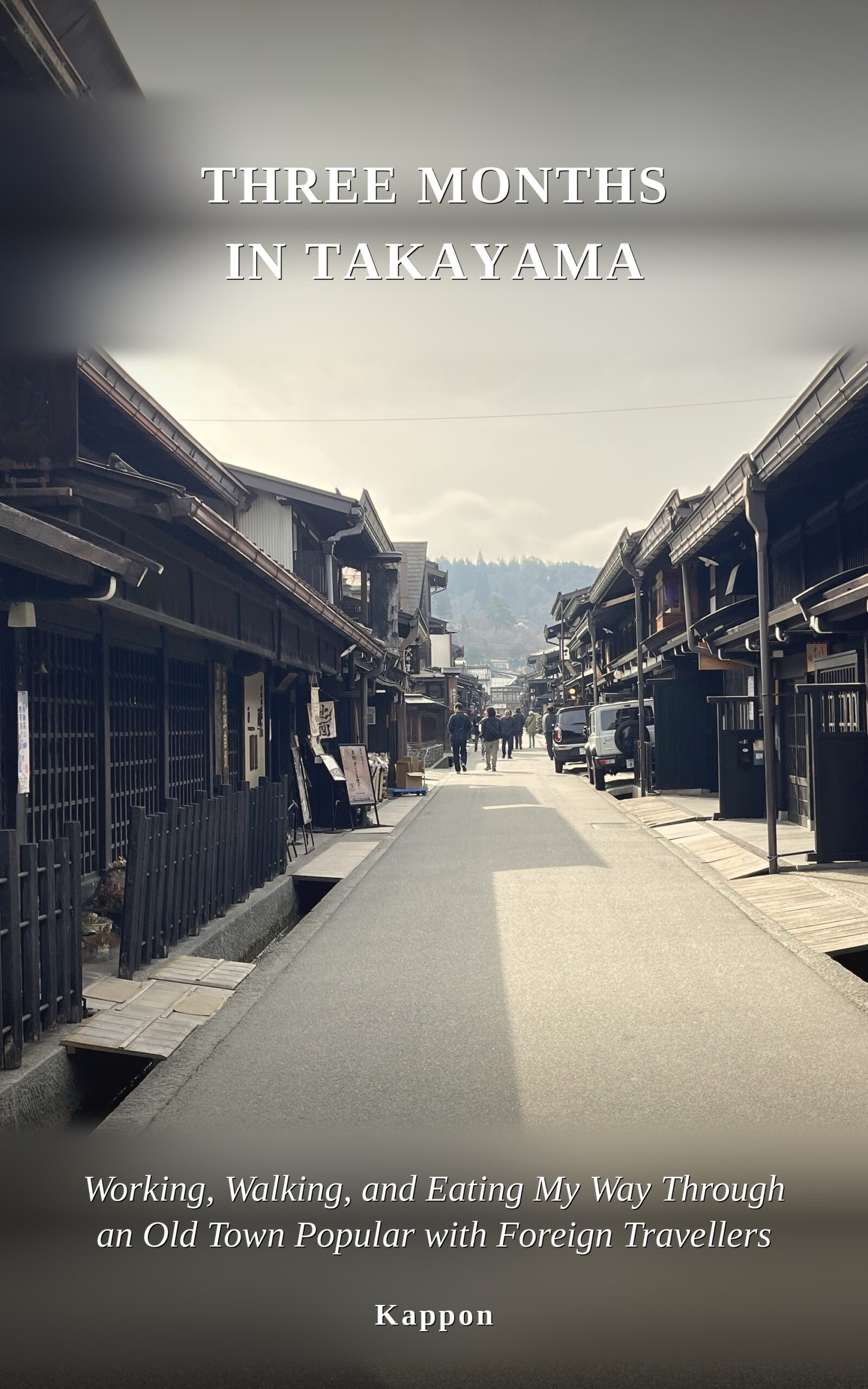
Want to read more about my time in Takayama?
I lived and worked in Takayama for three months, exploring the town and eating my way around it whenever I had time off. I ended up turning that experience into a short Kindle book, Three Months in Takayama.
Read Three Months in Takayama on Amazon →
